Email us: sales@valvesonlycanada.com

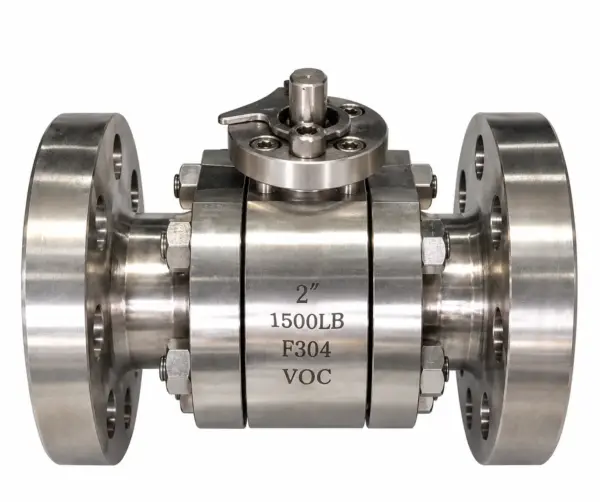
Floating Ball Valve
Floating Ball Valve Manufacturer in Canada
Reliable shut-off starts with floating ball valves designed for effective pipeline isolation and reliable sealing under line pressure. ValvesOnly Canada, a prominent Floating Ball Valve Manufacturer in Canada, delivers high-quality valves all around Toronto, Vancouver, Calgary, Edmonton, Montreal, and other Canadian areas.
Floating Ball Valve Product Specifications:
- Nominal Size: NPS ¼” to 24″
- Pressure Class: Class 150 to Class 800
- End Connections: Flanged, Butt Weld, Socket Weld, Threaded
- Design Standards: API 608, ISO 17292, ASME B16.34
- Inspection and Testing: API 598, Hydrostatic Shell Test, Seat Leakage Test
Floating Ball Valve Construction Details:
Body and Pressure Retaining Parts:
- ASTM A216 WCB
- ASTM A352 LCB
- ASTM A351 CF8 / CF8M
- ASTM A182 F304 / F316 / F316L
- ASTM A890 F51
- ASTM A351 Alloy 20 (CN7M)
- ASTM B564 Hastelloy C276 / B3
Internal Components:
- Ball: Stainless Steel / Duplex Stainless Steel / Hastelloy
- Stem: ASTM A182 F304 / F316
- Seat Ring: PTFE / RPTFE / PEEK / Metal Seat
Floating Ball Valve Sealing System:
- Seat: Soft Seated / Metal Seated
- Gasket: Graphite / Spiral Wound
- Packing: Graphite / PTFE
Floating Ball Valve Operating Principle:
A Floating Ball Valve works by permitting line pressure to act on the ball and force it against the downstream seat to create a positive bubble-tight seal. Because the ball is not fixed in position, it will automatically move in response to pressure. The self-adjusting sealing system, quarter-turn action and compactness make the valve highly reliable for providing isolation with very low operational torque and thus makes it ideal for industrial applications.
Floating Ball Valve Material Selection:
Standard Materials:
| Component | Material | Grade | Typical Application |
| Body | Carbon Steel | ASTM A216 WCB / ASTM A352 LCB | General industrial and pipeline service |
| Body | Stainless Steel | ASTM A351 CF8 / CF8M, ASTM A182 F304 / F316 / F316L | Corrosive process applications |
| Body | Duplex Stainless Steel | ASTM A890 F51 | Offshore and seawater service |
| Body | Alloy 20 | ASTM A351 CN7M | Acidic process systems |
| Body | Hastelloy | ASTM B564 C276 / B3 | Aggressive chemical service |
Additional Material Options:
- For highly chlorides applications, Super Duplex Stainless Steel F53 / F55 / 2507
- Inconel 625/718 for high temperature and pressure applications
- For nautical settings, Monel 400
- For saltwater uses, Titanium Grade 2 / Grade 5
- For project-specific operating settings, special trim materials and chair choices
Floating Ball Valve Design Features:
Valve Type: Floating Ball Valve
Operation:
- Manual
- Pneumatic Actuated
- Electric Actuated
- Gear Operated
Body Construction:
- Two Piece Body
- Three Piece Body
Port Configuration:
- Full Port
- Reduced Port
Performance Advantages:
- Self-sealing ball valve design
- Bubble-tight shut-off guaranteed
- Low operating torque required
- Compact and light weight construction
- Quarter turn actuation
- Easy to maintain
- Cost effective than the trunnion mounted valve design
- Can be used manually as well as automatically
Quality Testing:
- Hydrostatic Pressure Testing
- API 598 Seat Leakage Testing
- Operational Performance Testing
- Visual Inspection
- Dimensional Inspection
Floating Ball Valve Connection Options:
Our Floating Ball Valves are available with multiple end connection configurations to suit various industrial piping systems and installation requirements.
- Flanged as per ASME B16.5
- Butt Weld as per ASME B16.25
- Socket Weld
- Threaded (NPT / BSP)
- Customized end connections available based on project specifications
Floating Ball Valve Industrial Applications:
- Oil and gas industry: Moderate pressure processing plant and production facility
- Water and wastewater treatment industry: Distribution system, pumping station and utility lines
- Chemical process industry: Handling of corrosive fluids and process isolation
- Petrochemical industry: Refinery units and hydrocarbon processing facility
- Power industry: Utility lines and auxiliary process services
- Pipeline industry: Flow isolation in industrial pipeline network
- Marine industry: Seawater distribution and utility lines on board
- Mining industry: Process water systems and slurry transfer applications