Email us: sales@valvesonlycanada.com
Control Valve Manufacturer in Canada
Effective flow control is vital for sustaining industrial processes and control valves offer continuous flow, pressure, temperature and level control. As a well known Control Valve Manufacturer in Canada, ValvesOnly Canada supplies high-performance industrial control valves to customers across Toronto, Calgary, Edmonton, Vancouver, Montreal, and throughout Canada.
What is a Control Valve ?
The control valve serves as the final control element in any process control loop. The control valve controls the flow of fluids through the opening of the valve depending on the signals received from the control system. The control valve adjusts the parameters of the flow, such as flow rate, pressure, temperature, and level.
Different Types of Control Valves:
Selection depends on response time, control accuracy, and how the system needs to operate:
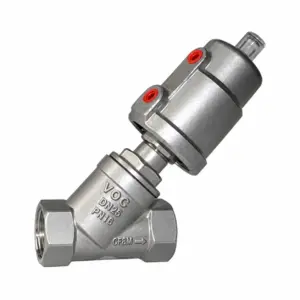
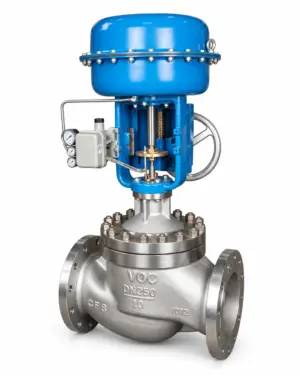
- Pneumatic Control Valve – uses air pressure to deliver fast, reliable response in demanding industrial settings
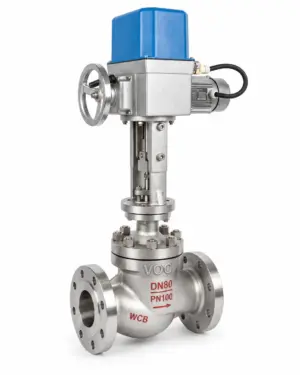
- Electric Control Valve – uses an electric actuator for precise positioning and remote operation in automated systems
How Does Control Valve Work?
A control valve translates a control signal into mechanical movement that adjusts flow through the valve body:
- The control system sends a signal, usually between 4 to 20 mA
- A positioner interprets that signal and drives the actuator accordingly
- The actuator moves the valve stem and plug into position
- The flow area changes, regulating pressure, flow, or temperature as needed
This constant adjustment keeps the process stable even as loads and conditions shift.
Actuation and System Integration:
Our control valves are built to integrate seamlessly into automated environments:
- Pneumatic actuators deliver fast, consistent response
- Electric actuators provide accurate, remote-operable positioning
- Positioners ensure precise valve placement
- I/P converters handle signal conversion where required
Each valve is designed for integration with PLC and DCS systems, supporting real-time process control.
Control Valve Material Grades:
Material selection is driven by process conditions, fluid properties, and the operating environment:
| Category | Material / Grade | Standard | Common Use |
| Carbon Steel | WCB, LCB, LCC | ASTM A216, A352 | General industrial service |
| Stainless Steel | F304, F316, F316L, F317L | ASTM A351, A182 | Corrosive and chemical processing |
| Duplex Steel | F51 (2205) | ASTM A890 | Offshore and seawater |
| Super Duplex | F53, F55, 2507 | ASTM A890 | High chloride environments |
| Alloy 20 | CN7M | ASTM A351 | Acidic applications |
| Hastelloy | C276, B3 | ASTM B564 | Aggressive chemical service |
| Inconel | 625, 718 | ASTM B564 | High temperature applications |
| Incoloy | 800, 825 | ASTM B564 | Thermal systems |
| Titanium | Grade 2, Grade 5 | ASTM B348 | Marine and desalination |
Control Valve Standards and Testing:
Every control valve is designed and tested to ASME B16.34, IEC 60534, ANSI/FCI 70-2, and applicable ISA standards. Before dispatch, valves go through hydrostatic and pressure testing, seat leakage testing per ANSI/FCI 70-2, functional testing of the actuator and positioner, and full calibration verification.
Control Valve Features and Benefits:
- Trim designed to match the conditions of flow and pressure
- Cavitation resistant trims, suitable for severe conditions and quiet
- Excellent rangeability for highly accurate control
- Fail-safe control valve features include both fail-open and fail-close
- Fully compatible with automated systems
- Durable for high pressure and temperature environments
Control Valve Applications and Industries:
ValvesOnly Canada control valves support demanding operations across:
- Oil sands processing and refining
- Power generation and thermal systems
- Water treatment and distribution networks
- Petrochemical processing units
- Marine and offshore systems
- Mining and slurry handling
Control Valve Sizing and Selection:
The correct sizing is what makes the difference between a good performing control valve and a merely installed one. If the valve is undersized, it will be hard to cope with its duty; if it is oversized, the risks of poor regulation, cavitation, and rapid wearing appear. In order to size properly, it is necessary to choose a correct trim characteristic according to the process dynamics and select an appropriate actuator which will deal with the pressure drop.
With engineering support, custom trim and actuator configurations, and dependable delivery across Canada, ValvesOnly Canada supplies control valves for industrial projects requiring precise regulation, process stability, and long-term reliability.