Email us: sales@valvesonlycanada.com
Safety Valve Manufacturer in Canada
Safe and efficient industrial operations depend on reliable overpressure protection. ValvesOnly Canada, a top Safety Valve Manufacturer in Canada, manufactures durable pressure relief valves designed to safeguard critical systems across Toronto, Calgary, Edmonton, Vancouver, Montreal, and throughout Canada.
What Is the Function of a Safety Valve?
The safety valve is the pressure relief component which will remain in the closed position until the pressure in the system rises above a predetermined level. This excess pressure will then be discharged from the system after which the safety valve will shut automatically without any external assistance. The safety valve plays a crucial role in protecting equipment exposed to steam, gas, and vapor services.
How a Safety Valve Operates?
The action is entirely mechanical and automatic:
- System pressure bears down on the disc or seat area
- Spring force, or a pilot mechanism, keeps the valve sealed shut during normal service
- Once pressure hits the set point, the disc lifts and vents the excess
- As pressure drops back to the reseating level, the valve shuts again
This self-regulating cycle protects equipment without relying on human response time.
Safety Valve Types We Manufacture:
Different systems call for different relief mechanisms:
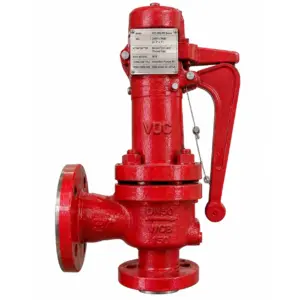
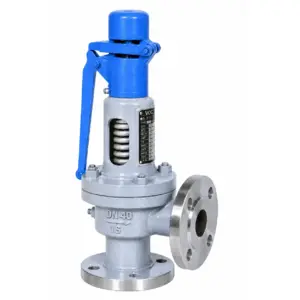
- Spring Loaded Safety Valve – opens directly at set pressure using spring force, suited for general overpressure protection
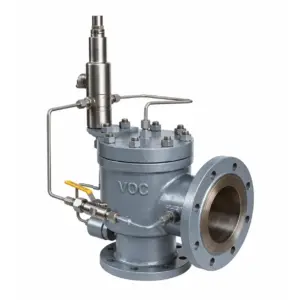
- Pilot Operated Safety Valve – uses a pilot mechanism for tighter set-pressure control in higher-pressure systems
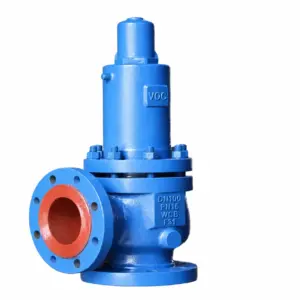
- Conventional Safety Valve – a standard direct-acting design for applications with limited back pressure
- Bellow Seal Safety Valve – isolates the spring chamber from back pressure or corrosive media for stable performance
Sizing and Performance Factors:
Proper selection of a safety valve involves much more than selecting the correct set pressure. Medium relief temperature, backpressure conditions, blowdown considerations, discharge flow rate, and pressure drop at inlet and outlet are among the considerations for proper selection. Failure to take account of these parameters correctly may have an adverse impact on performance.
Material Selection Guide:
Material choice comes down to operating pressure, temperature, and the media involved:
| Category | Material / Grade | Standard | Common Use |
| Carbon Steel | WCB, WCC, LCB | ASTM A216, A352 | Steam service, general pressure protection |
| Stainless Steel | F304, F316, F316L, F321, F347 | ASTM A351, A182 | Corrosive service, high-temperature applications |
| Duplex Steel | F51 (2205) | ASTM A890 | Offshore, chloride-bearing media |
| Super Duplex | F53, F55, 2507 | ASTM A890 | Aggressive marine, high chloride conditions |
| Alloy 20 | CN7M | ASTM A351 | Acidic process systems |
| Hastelloy | C276, B3 | ASTM B564 | Severe chemical service |
| Inconel | 625, 718 | ASTM B564 | High-temperature, high-pressure systems |
| Incoloy | 800, 825 | ASTM B564 | Thermal and corrosive service |
| Titanium | Grade 2, Grade 5 | ASTM B348 | Marine and corrosive duty |
Standards and Testing:
Every safety valve we manufacture is designed to ASME Section VIII, API 520, API 526, API 527, and ASME B16.34. Before dispatch, valves are put through hydrostatic testing, set pressure testing, seat tightness testing, blowdown verification, and full capacity and functional testing to confirm accurate opening pressure, reliable discharge, and consistent reseating.
Key Benefits of Safety Valves:
- Accurate spring calibration for set pressure control
- Bellows design for back pressure compensation
- Soft or metal seated options depending on service
- Compact or high-capacity configurations
- Corrosion-resistant trims for severe media
- Built for high-temperature and high-pressure duty
Where Safety Valves Are Used?
From Calgary\'s oil and gas operations to power generation plants in Ontario and heavy industrial facilities across British Columbia, ValvesOnly Canada safety valves protect:
- Power generation systems
- Oil and gas processing facilities
- Petrochemical and refining plants
- Steam and boiler systems
- Water and utility pressure systems
- Mining and heavy industrial plants
Get the Right Safety Valve for Your System:
Correct size is what makes a safety valve become a functional safety valve. Ensuring that the set pressure corresponds to the actual process conditions, considering back pressure and blowdown characteristics, and ensuring that the safety valve provides the discharge capacity that it should is how the system will be safe.
ValvesOnly Canada designs each valve for exact spring setting and reseating reliability, with custom configurations delivered to your facility in Calgary, Edmonton, Toronto, Vancouver, and other cities.