Email us: sales@valvesonlycanada.com

Ball Valve Manufacturer in Canada
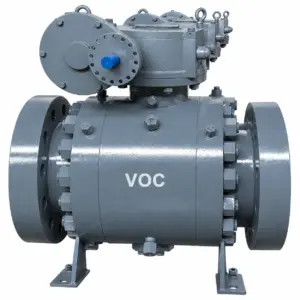
A ball valve is a rotary shutoff valve that employs the use of a ball with a hole running through it. This ball is rotated 90 degrees to close or open the valve. As a leading Ball Valve Manufacturer in Canada, ValvesOnly Canada builds that same reliability into every valve, supplying configurations for pipeline isolation, process systems, and utility services to facilities across Calgary, Edmonton, Toronto, Vancouver, and beyond.
How Does a Ball Valve Work?
The heart of each ball valve is a rotating ball that has a hole bored through it. The ball can be rotated 90 degrees in order for its hole to align with the pipeline, thus allowing an unhindered flow of materials. Rotating it in the opposite direction will make the hole perpendicular to the flow, thus stopping any material from flowing through. This allows for quick rotation of the ball and a lower torque as it does not require more than a quarter turn.
What Is a Ball Valve Used For?
Ball valves, in essence, are shut-off valves which were created for either total opening or closing of the line rather than flow control. There are, however, special models available for controlling the flow in cases when it is required. The ability to close tightly and provide a full bore with quick operation makes ball valves ideal for isolating pipelines.
Types of Ball Valves:
Different pipeline conditions call for different ball valve designs:
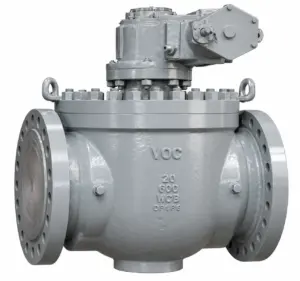
- Trunnion Ball Valve – supported at both the top and bottom, making it suited for high-pressure and large-diameter pipelines where the ball needs extra structural support.
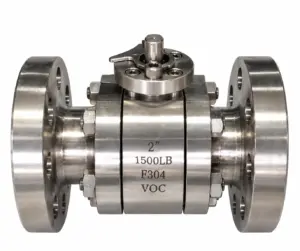
- Floating Ball Valve – the ball itself shifts slightly under line pressure to seal against the downstream seat, a design that works well in low to medium pressure systems.
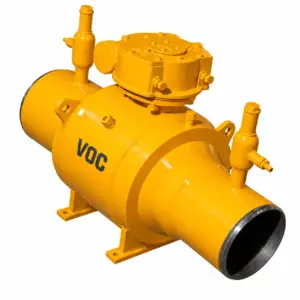
- Fully Welded Ball Valve – body sections are welded rather than bolted, providing the durability needed for buried pipelines and underground installations.
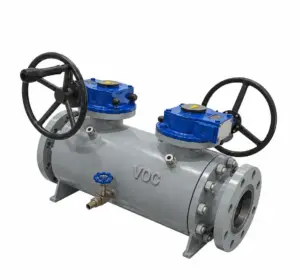
- Double Block and Bleed Ball Valve – provides dual isolation through two independent sealing surfaces with a bleed port between them for critical applications.
Ball Valve Material Grades:
Material selection changes with pressure rating, temperature, and the media being handled. Grouped by category:
| Category | Material / Grade | Standard | Common Use |
| Carbon Steel | WCB, LCB, LCC | ASTM A216, A352 | Pipeline and general industrial service |
| Stainless Steel | F304, F316, F316L, F317L | ASTM A351, A182 | Corrosive service environments |
| Duplex Steel | F51 (2205) | ASTM A890 | Offshore and seawater exposure |
| Super Duplex | F53, F55, 2507 | ASTM A890 | High chloride environments |
| Alloy 20 | CN7M | ASTM A351 | Acidic process systems |
| Hastelloy | C276, B3 | ASTM B564 | Aggressive chemical processing |
| Inconel | 625, 718 | ASTM B564 | High-temperature service |
| Titanium | Grade 2, Grade 5 | ASTM B348 | Marine applications |
Ball Valve Performance Specifications:
- Full bore design ensures free flow and minimizes pressure loss.
- Bi-directional sealing function is irrespective of the direction of flow.
- Quarter turn operation ensures rapid and reliable shut-off.
- Suitable for harsh environments where high-pressure and high-temperature are common.
- Electrically or pneumatically operated for automation purposes.
Standards and Testing:
Manufacturing follows API 6D and API 608, the core design standards for pipeline ball valves and petroleum ball valve service, alongside ASME B16.34 for pressure-temperature ratings, ISO 17292, and BS EN 1983. Before dispatch, valves are verified through hydrostatic testing, seat leakage testing, and fire-safe testing to API 607 / API 6FA where the application requires it.
Built-In Reliability Features:
- Blowout-proof stem construction
- Anti-static devices for safe, consistent operation
- Fire-safe design where service conditions demand it
- Extended stem configurations for buried pipelines
- Low-emission sealing to limit fugitive emissions
- Ready for automation with electric actuators or pneumatic actuators
Industries That Rely on Our Ball Valves:
From oil sands extraction and pipeline transmission to petrochemical refining, power generation, water treatment and desalination, marine and offshore platforms, and mining and metal processing, ValvesOnly Canada ball valves are built into the infrastructure these sectors depend on daily.
Selecting the Right Ball Valve:
The pressure range, operating temperature, media, and actuation of a ball valve are important factors in determining which ball valve to select. Failure to consider any of these could lead to unreliability in the long run. At ValvesOnly Canada, we guide our customers in selecting a reliable ball valve solution.