Email us: sales@valvesonlycanada.com

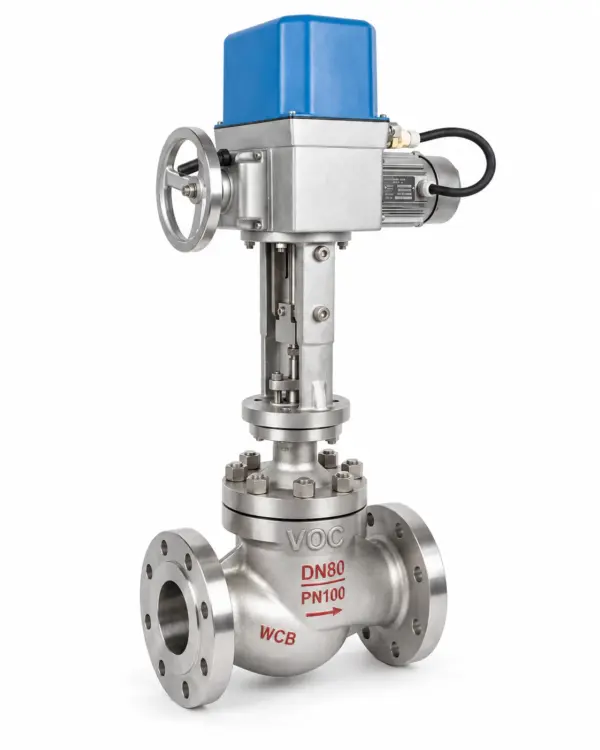
Electric Control Valve
An electric control valve is an automated control valve that uses an electric actuator to control the flow, pressure, temperature, or level of the fluid in the pipe. As opposed to a manually controlled valve, it receives input from a control system that allows it to move to the required position continuously. As a prominent Electric Control Valve Manufacturer in Canada, ValvesOnly Canada manufactures high-performance electric actuated control valves that are designed for reliable automation in Toronto, Calgary, Edmonton, Montreal, and across Canada.
Electric Control Valve Technical Specifications and Operating Parameters:
- Nominal Size: DN15 to DN600
- Pressure Rating: PN10 to PN100 / ANSI Class 150 to Class 600
- Temperature Range: Based on valve material and seat selection
- Actuation Type: Electric Actuator
- Control Type: On/Off Control and Modulating Control
- Control Signal: 4-20 mA, 0-10 V, Digital Communication Protocols
- Design Standards: IEC 60534, ASME B16.34
- Inspection and Testing: API 598, IEC 60534
Electric Control Valve Construction and Materials of Construction:
Pressure-Retaining Material Options:
- ASTM A216 WCB
- ASTM A351 CF8
- ASTM A351 CF8M
- ASTM A182 F316
- ASTM A890 F51
Internal Flow Control Components:
- Trim: Stainless Steel, Hardened Stainless Steel
- Stem: ASTM A182 F316, ASTM A182 F6a
- Seat Ring: Stainless Steel / Metal Seat / Soft Seat
Electric Actuation and Control Components:
- Actuator: Electric Multi-Turn or Quarter-Turn Electric Actuator
- Positioner: Digital Positioner for accurate Valve Positioning
- Control Interface: 4-20 mA, Modbus, HART Communication
Electric Control Valve Sealing Arrangement:
- Seat: Soft Seated / Metal Seated
- Packing: Graphite / PTFE
- Gasket: Graphite / Spiral Wound
How Does an Electric Control Valve Work?
The Electric Control Valve works by getting the instructions from the Control System, which can either be a PLC or DCS system. In response to the signal, the Electric Actuator will work to control the opening of the valve depending on varying process requirements.
Through converting electrical energy to mechanical energy, the actuator enables the valve to regulate flow, pressure, temperature, and level. An Electric Actuated Control Valve does not require manual manipulation like the manual valves.
Electric Control Valve Material Grades and Alloy Availability:
Standard Material Options:
| Component | Material | Grade | Typical Application |
| Body | Carbon Steel | ASTM A216 WCB | General industrial service |
| Body | Stainless Steel | ASTM A351 CF8 / CF8M | Corrosive process media |
| Body | Duplex Stainless Steel | ASTM A890 F51 | Offshore and chloride environments |
| Trim | Stainless Steel | ASTM A182 F316 | Accurate flow regulation |
| Stem | Stainless Steel | ASTM A182 F316 / F6a | Corrosion resistance and durability |
| Seat Ring | Stainless Steel | ASTM A182 F316 | Reliable sealing performance |
Extended Alloy Options Available:
- Alloy 20 (CN7M) for acidic and chemical process applications
- Duplex Stainless Steel (F51) for corrosive process fluids and chlorides
- Inconel 625 for high temperatures and pressures
- Hastelloy C276 for highly corrosive conditions
Electric Control Valve Design Features and System Integration Options:
- High accuracy Valve Positioning
- Reliable Remote Operation
- Facilitates Full Industrial Automation
- Suitable for PLC & DCS Systems
- Modulating Valve Options Available
- Less Requirement of Manual Handling
- Higher Efficiency of Process
- Low Maintenance Operations
- Appropriate for Continuous Process Control
- Industrial Flow Control Applications
Electric Control Valve End Connection Configurations:
- Flanged Connections as per ASME B16.5
- Threaded Connections as per ASME B1.20.1
- Butt Weld Connections as per ASME B16.25
- Customized end connections based on project requirements
Electric Control Valve Applications Across Industrial Sectors:
- Water and Wastewater Treatment: Automated flow regulation and process control
- Oil and Gas Processing: Pressure and flow management systems
- Mining and Mineral Processing: Slurry and process fluid regulation
- Marine and Offshore Facilities: Automated utility and control systems
- Power Generation: Cooling water and steam control applications
- Petrochemical Plants: Process automation and flow adjustment
- Chemical Processing: Accurate media control and regulation