Email us: sales@valvesonlycanada.com

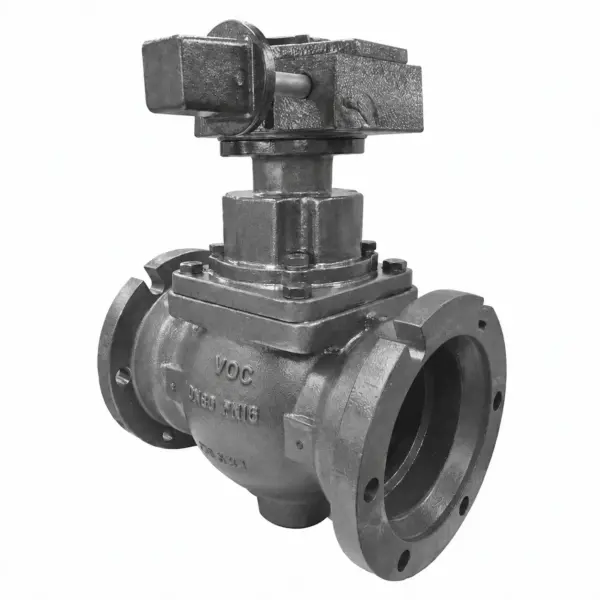
Lubricated Plug Valve
Lubricated Plug Valve Manufacturer in Canada offering Class 150–2500, ASTM A216 WCB bodies and sealant injection for secure isolation in oil and gas systems.
A lubricated plug valve uses a metal plug and a sealant system to maintain sealing between the plug and body. Sealant is introduced through an injection fitting and distributed along internal grooves. It helps reduce operating friction and supports shut-off, but must be compatible with the process fluid and temperature.
As a Lubricated Plug Valve Manufacturer in Canada, Valves Only Canada supplies valves for hydrocarbon pipelines, refineries and industrial process systems. Conventional and pressure-balanced constructions are available for different operating duties. Maintenance includes checking the sealant condition and replenishing it according to the valve manufacturer’s instructions.
Features
- Quarter-turn pipeline isolation
- Integral sealant injection fitting and distribution passages
- Metal plug and body seating surfaces
- Pressure-balanced configurations for demanding duties
- Full-port and reduced-port options
- Manual or automated operation
- Sealant replenishment without dismantling in suitable designs
Technical Specifications
| Parameter | Specification |
| Valve Type | Lubricated Plug Valve |
| Design | Tapered or cylindrical plug |
| Construction | Conventional or pressure-balanced |
| Nominal Size | DN15 to DN600 |
| Pressure Rating | ASME Class 150, 300, 600, 900, 1500 or 2500 |
| Carbon Steel Body | ASTM A216 WCB |
| Stainless Steel Body | ASTM A351 CF8M |
| Alloy Steel Body | ASTM A217 WC6 / WC9 |
| Sealing System | Metal seating surfaces with injected lubricant/sealant |
| Lubrication System | Injection fitting with internal distribution grooves |
| Flow Passage | Full port or reduced port |
| End Connections | Flanged / Butt-Weld / Threaded |
| Operation | Lever / Gear / Pneumatic / Electric |
| Installation | Horizontal or vertical |
Standards and Testing
API 599 may apply to general industrial metal plug valves, while API 6D applies to qualifying pipeline designs. Inspection and pressure testing should follow the applicable design standard, including API 598 where specified.
Connection requirements may include ASME B16.5 or B16.47 for flanges, ASME B16.25 for butt-weld ends and ASME B1.20.1 for threaded ends. ASME B16.10 applies to covered dimensional configurations.
Industries Served in Canada
- Oil and Gas
- Refineries and Petrochemical
- Natural Gas Processing
- Chemical Processing
- Pipeline Transportation
- Hydrocarbon Storage and Transfer