Email us: sales@valvesonlycanada.com

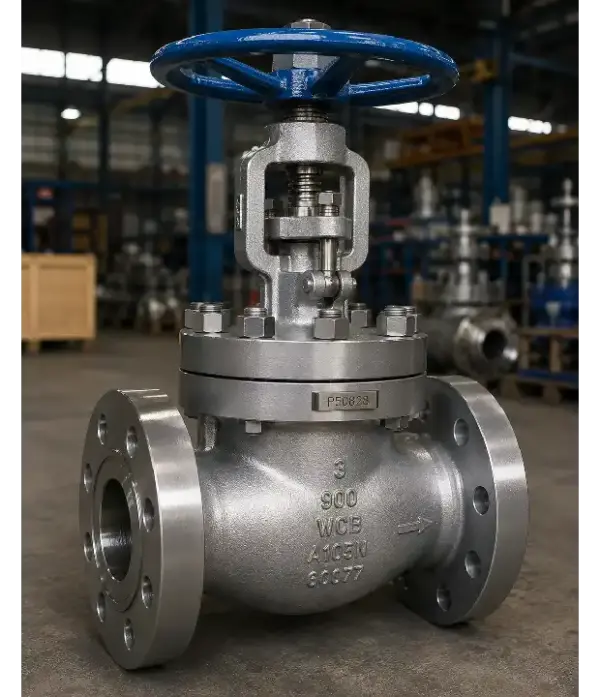
Pressure Seal Globe Valve
Pressure Seal Globe Valve Manufacturer in Canada
Pressure Seal Globe Valve Performance Data:
- Nominal Size: 2″ to 24″
- Pressure Class: Class 900 to Class 2500
- Temperature Range: -29°C to +650°C
- Design Standards: ASME B16.34, BS 1873
- Face to Face: ASME B16.10
- Inspection and Testing: API 598, ISO 5208
- Construction Type: Pressure Seal Bonnet, OS&Y, Bolted Bonnet
Pressure Seal Globe Valve Construction Features:
Primary Pressure Components:
- ASTM A216 WCB
- ASTM A217 WC6
- ASTM A217 WC9
- ASTM A182 F11
- ASTM A182 F22
- ASTM A182 F91
- ASTM A351 CF8M
- ASTM A182 F316
Valve Operating Components:
- Disc: Plug Disc / Renewable Disc
- Stem: ASTM A182 F6a / F316
- Seat Ring: Renewable Seat Ring with Stellite Overlay
- Backseat: Integral Backseat Design
Bonnet Sealing Assembly:
- Packing: Flexible Graphite
- Pressure Seal Gasket: Graphite / Stainless Steel
- Stem Seal: Low Emission Graphite Packing available for API 624 and ISO 15848 compliance
Pressure Seal Globe Valve Working Principle:
Pressure Seal Globe Valve is engineered for accurate flow regulation and dependable shut-off in high-pressure and high-temperature piping systems. The threaded stem moves the disc linearly towards or away from the seat to control the flow of steam, oil, gas, and process fluids. Unlike conventional bolted bonnet valves, the pressure seal bonnet utilizes internal line pressure to enhance the seal between the bonnet and valve body, providing improved leak-tight performance as operating pressure increases. This self-energizing sealing design reduces bolting stress, minimizes maintenance requirements, and delivers reliable performance in critical services such as power generation, refineries, petrochemical plants, and industrial process systems. The valve is widely used where severe operating conditions demand exceptional pressure integrity and long service life.
Pressure Seal Globe Valve Material Options:
Available Standard Materials:
| Component | Material | Grade | Typical Application |
| Body | Carbon Steel | ASTM A216 WCB | High-pressure oil, gas and steam service |
| Body | Chrome Moly Steel | ASTM A217 WC6 | High-temperature steam systems |
| Body | Chrome Moly Steel | ASTM A217 WC9 | Power generation and refinery applications |
| Body | Forged Alloy Steel | ASTM A182 F11 / F22 | High-pressure process piping |
| Body | Chrome Moly Alloy Steel | ASTM A182 F91 | Superheated steam and severe service |
| Body | Stainless Steel | ASTM A351 CF8M | Corrosive process media |
| Disc | Stainless Steel | ASTM A182 F316 | Precise flow regulation and shut-off |
| Stem | Stainless Steel | ASTM A182 F6a / F316 | Corrosion resistance and reliable operation |
| Seat Ring | Stainless Steel with Stellite Overlay | Hard Faced | Wear resistance and leak-tight sealing |
Optional Construction Materials:
- Low Temperature Carbon Steel (LCB / LCC) for low-temperature service
- Duplex Stainless Steel (F51) for offshore and seawater applications
- Super Duplex Stainless Steel (F55 / F53) for high chloride environments
- Alloy 20 (CN7M) for acidic chemical processing
- Hastelloy C276 for aggressive chemical media
- Inconel 625 / 718 for high-temperature and severe service applications
- Monel 400 for marine and saltwater systems
Pressure Seal Globe Valve Specifications:
| Parameter | Specification |
| Valve Type | Pressure Seal Globe Valve |
| Operation | Manual / Gear Operated / Electric Actuated / Pneumatic Actuated |
| Bonnet Design | Pressure Seal Bonnet |
| Flow Characteristics | Linear Flow Control |
| Leakage Control | Tight Shut-Off |
| Pressure Capability | Class 900 to Class 2500 |
| Temperature Capability | Suitable for service from -29°C to +650°C |
| Service Media | Steam, Oil, Gas, Water, Condensate and Process Fluids |
Available Connection Configurations:
- Raised Face (RF) as per ASME B16.5
- Ring Type Joint (RTJ) as per ASME B16.5
- Butt Weld (BW) as per ASME B16.25
Custom end connections available to meet project specifications
Pressure Seal Globe Valve Service Applications:
- Power generation plants: Precise flow control in main steam, boiler feed, and turbine auxiliary systems.
- Oil refineries: Isolation and throttling of high-pressure hydrocarbons and process fluids.
- Petrochemical plants: Reliable operation in high-temperature and high-pressure process units.
- Steam generation systems: Accurate flow regulation in superheated steam and condensate pipelines.
- Oil and gas industry: High-pressure isolation and flow control in upstream and downstream facilities.
- Chemical processing plants: Safe handling of corrosive and hazardous process media with suitable material grades.
- Fertilizer plants: Flow control for ammonia, urea, and other chemical processing systems.
- Industrial process plants: Continuous operation in critical utility and production pipelines.
- Marine and offshore facilities: High-pressure service for steam, fuel, and utility piping systems.